

Buddha painting postures – meaning, appearance, and guidance for choosing
- Date: April 23, 2026
- By: Alex Brandt
A Buddha painting is more than just a stylish piece of art on the wall. The posture, gaze, and expression of the Buddha largely determine the atmosphere and energy the painting brings into your interior. The meaning of a Buddha posture therefore plays an important role in choosing the right Buddha painting.
Many people choose a painting purely based on color or appearance, but the posture of the Buddha carries a deeper meaning. It can influence how a space feels: calming, powerful, spiritual, or energizing.
But how do you recognize these differences? And more importantly: which Buddha painting posture best suits your interior and feeling?
In this article, you will discover:
- what the different Buddha postures mean
- what kind of atmosphere they create in your home
- how to make the right choice


Traditional Buddha postures vs modern art
In traditional Buddhist art, different Buddha postures and hand gestures (mudras) each carry a specific spiritual meaning, such as protection, enlightenment, or wisdom.
In modern, hand-painted Buddha art, however, the focus is less on this fixed symbolism and more on expression, emotion, and energy.
The paintings in this collection are therefore not based on traditional mudras, but on:
- the expression of peace, balance, or strength
- the posture and gaze of the Buddha
- the use of color and composition
This gives each Buddha painting a unique appearance that fits both a modern interior and a personal experience.
Buddha painting with closed eyes – peace, meditation, and balance
The most common and recognizable Buddha painting posture is a face with closed eyes. This image symbolizes inner peace, meditation and letting go of external stimuli.
A Buddha with closed eyes does not look at the outside world, but turns inward. This makes this type of painting especially powerful for creating a calm and relaxed living environment.
What does this posture express?
- deep relaxation
- mental calm
- balance and harmony
- spirituality
Why do people choose this?
In a busy daily life, many people seek moments of rest. A Buddha painting with closed eyes subconsciously helps to bring that sense of calm back into the home. It almost works as an anchor point of tranquility.
Where does it fit best?
- in the living room for a peaceful atmosphere
- in the bedroom for relaxation
- in a meditation or yoga space
Within our collection of hand-painted Buddha paintings you will find this posture in:
These paintings combine calm expression with powerful color compositions, making them both soothing and visually engaging.
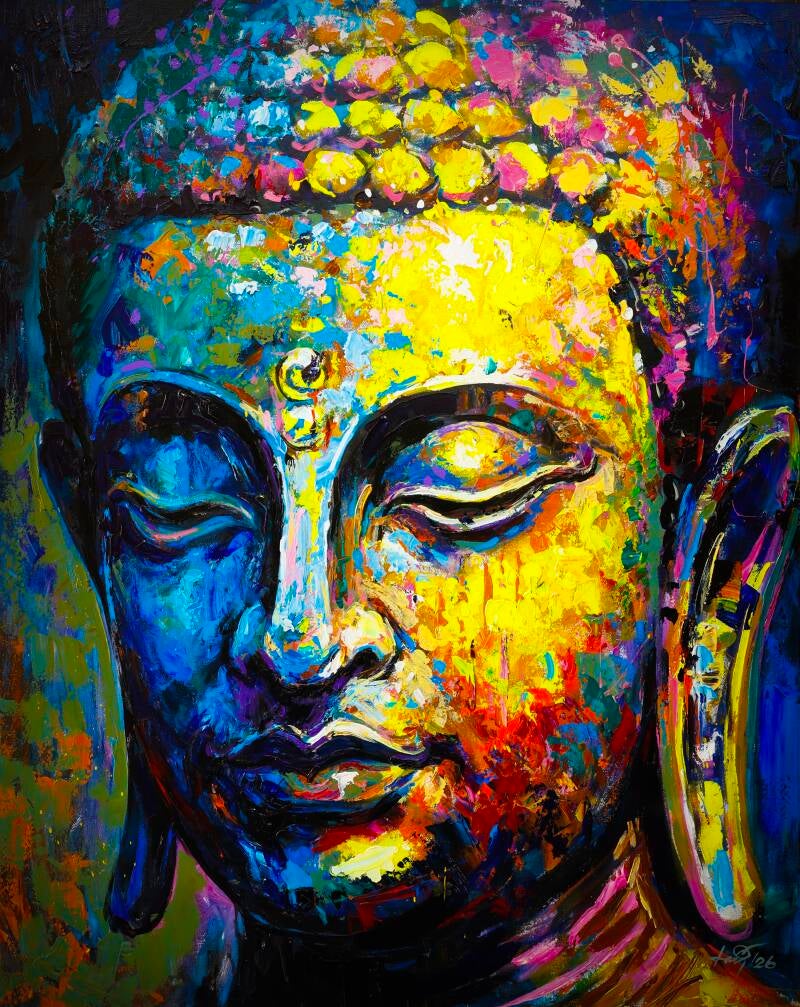


Frontal Buddha posture – strength, focus, and presence
A frontal Buddha painting (depicted straight from the front) has a completely different impact. While closed eyes often bring calm, a frontal posture creates presence, strength, and balance. Through symmetry and the direct gaze, a strong visual focal point is created in the space.
What does this posture mean?
- inner strength
- stability
- focus and awareness
- balance between body and mind
What does this do in your interior?
A frontal Buddha immediately draws attention and gives structure to a space. It feels as if the painting is “present,” without being dominant.
Ideal for:
- a large living room
- above a sofa or sideboard
- as a statement piece
Within our collection of hand-painted Buddha paintings, you will find this posture in:
These artworks are perfect as a large Buddha painting in the living room, as they combine balance and strength with a luxurious appearance.


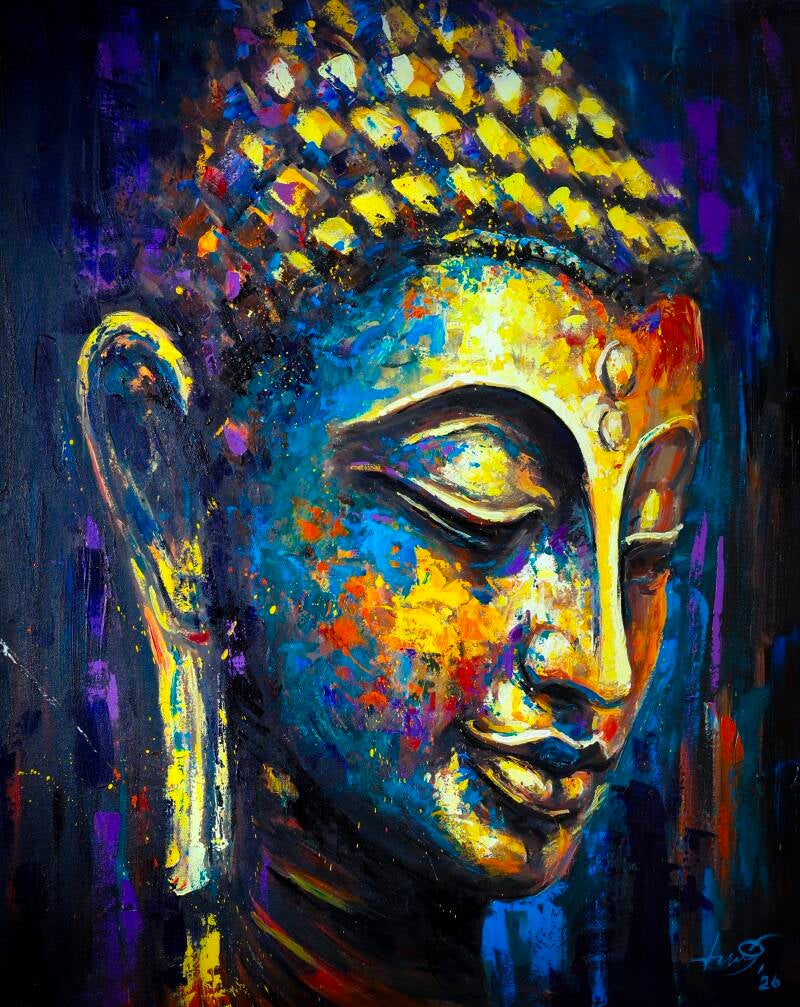
Turned Buddha posture – softness, depth, and elegance
A slightly turned or sideways posture (also called a 3/4 profile) creates a more subtle and refined appearance. This type of Buddha painting feels less direct and adds more movement to the image.
What makes this posture special?
- less “hard” present
- more dynamics and depth
- softer appearance
What does it express?
- elegance
- calm with movement
- natural balance
- refinement
This posture is ideal for people who want a calm atmosphere, but without it feeling too static or heavy.
Perfect for:
- modern interiors
- minimalist spaces
- stylish living rooms
Within our collection of hand-painted Buddha paintings, you will find this posture in:
These paintings give a space a luxurious and calm appearance, with just a bit more depth and character.


Color and energy – the emotion of a Buddha painting
In addition to posture, the use of color plays a major role in how a Buddha painting is experienced. In many modern, hand-painted works, color is even one of the most important elements that determine the energy and appearance.
Where traditional Buddha art is often more restrained, modern paintings bring expression and emotion through color.
What do colors do in a painting?
- Blue → calm, depth, and tranquility
- Yellow / gold → warmth, enlightenment, and spirituality
- Red / orange → energy, strength, and passion
- Contrasts → dynamics and expression
What does this mean for your choice?
Two Buddha paintings with the same posture can feel completely different due to the use of color. That is why it is important to look not only at the posture, but also at the energy and appearance of colors.
Within the collection of hand-painted Buddha paintings, the power of color and energy is clearly reflected in, among others:
- Energy Flow → powerful colors and dynamic appearance
- Silent Strength → deep colors and strong appearance
- Colorful Calm → soft colors and playful appearance
- Golden Serenity → warm golden tones and a luxurious appearance
This makes each hand-painted Buddha painting unique — both visually and emotionally.


Which Buddha painting posture suits your interior?
The right choice depends on what you want to express in your space.
Choose consciously:
✔️ Do you want peace and relaxation?
→ choose a Buddha with closed eyes
✔️ Do you want strength and focus?
→ choose a frontal Buddha painting
✔️ Do you want elegance and softness?
→ choose a turned posture
In addition, it is important to consider:
- the size (large Buddha painting living room)
- the colors in your interior
- natural light and placement
A well-chosen painting can not only make a space more beautiful, but also completely transform its atmosphere.

Where Should You Hang a Buddha Painting?
In this blog you will discover where a Buddha painting is best placed according to Buddhist traditions and the symbolic meaning of respect, peace and harmony.

What to Look for When Buying a Buddha Painting?
In this blog, you will learn what to consider when choosing or buying a Buddha painting, from its expression and size to the meaning and origin of the artwork.

Buddha painting living room: tips & inspiration
In this blog, we share practical tips, inspiration, and examples to help you choose the perfect Buddha painting for your living room.
Why choose a hand-painted Buddha painting?
A hand-painted Buddha painting has a character that you simply cannot achieve with prints or mass production.
You can see:
- brush strokes
- texture
- depth
- true color experience
Our paintings:
- are hand-painted in Thailand
- are unique (1/1)
- are blessed by a monk
- come with a certificate of authenticity
This means you are not just bringing art into your home, but also a story and meaning.

Discover your perfect Buddha painting
Whether you choose peace, balance, strength or energy — there is always a painting that perfectly suits you.
“Don’t just choose a painting — choose the energy you want to feel every day.”
Meer blogs van Original Buddha Art

The Beginning of Original Buddha Art
In this blog you will read how Original Buddha Art began after a meeting with Thai artist Seksak Jaichumchen and his Buddha paintings from Thailand.

The blessing of Buddha paintings
In this blog, you will learn why Buddha paintings in Thailand are blessed by a monk and the spiritual meaning behind this tradition.

Where do you place a Buddha painting?
In this blog, you will discover the best place to hang a Buddha painting according to Buddhist traditions and the symbolic meaning of respect, peace, and harmony.

Meaning of Buddha paintings in your home
In this blog, you will read about the meaning of a Buddha painting and why Buddha art is often chosen to bring peace, balance, and harmony into an interior.

Is it appropriate to have a Buddha at home?
In this blog, you will learn whether it is appropriate to have a Buddha image at home, how this is viewed in Thailand, and what Buddha art can represent in a living space.

What to consider when buying a Buddha painting?
In this blog, you will discover what to look for when choosing or buying a Buddha painting, from appearance and size to the meaning and origin of the artwork.

Buddha painting living room: tips & inspiration
In this blog, we share practical tips, inspiration, and examples to help you choose the perfect Buddha painting for your living room.

Hand-painted or printed Buddha painting?
In this blog, you will learn what the difference is between a hand-painted and printed Buddha painting, and discover which choice best suits quality, appearance, and meaning.

Can you buy a Buddha painting for yourself?
In this blog, you will learn where the idea comes from that you should receive a Buddha as a gift, and discover why you can also buy one yourself.

What does a Buddha painting cost?
In this blog, you will learn what a Buddha painting costs, which factors determine the price, and why hand-painted, authentic art often has a higher value than prints.

Where to buy an authentic Buddha painting?
In this blog, you will learn where to buy a truly hand-painted Buddha painting and what to look for to recognize quality, authenticity, and visual appeal.

What does a laughing Buddha mean?
In this blog, you will discover what the laughing Buddha represents, where he comes from, and why he is a symbol of happiness, abundance, and inner contentment.