

Are you allowed to buy a Buddha painting for yourself?
- Date: May 7, 2026
- By: Alex Brandt
Giving or receiving a Buddha painting is often seen as something special. It symbolizes peace, balance and mindful living. Yet in Europe you often hear a persistent belief: “A Buddha only brings good luck if it is received as a gift.”
Some people even go further and say it brings bad luck if you buy one yourself. But where does this idea come from? And more importantly: is it actually true?
The European myth: good luck only if you receive a Buddha as a gift
In many European countries, the idea has emerged that a Buddha:
- brings good luck if it is received as a gift
- has less power if you buy it yourself
- or even “should not” be purchased by yourself
This sounds mystical and appealing, but it is important to understand: This is not an official Buddhist rule.
It is a belief that has mainly developed in the West — a mix of spirituality, interpretation and a bit of superstition.
Why do so many people believe this?
The popularity of this myth did not arise out of nowhere. There are several clear reasons why this idea is so persistent.
1. The power of gift symbolism
In many cultures, a gift has a deeper meaning than something you buy for yourself.
Giving a Buddha as a gift feels like:
- wishing someone peace
- giving happiness
- marking a new beginning
This led to the idea that the power of the object is stronger when it is given.
But this says more about how we in Europe view gifts than about Buddhism itself.

2. Confusion with the “laughing Buddha” (Budai)
An important source of confusion is the laughing Buddha (often depicted with a round belly and a joyful expression).
In Feng Shui and folklore, this figure is:
- often given as a gift
- associated with luck and prosperity
This led to the idea that this applies to all Buddha images — which is simply not true.
A traditional Buddha painting has a very different background and meaning.
3. Misinterpretation of Asian traditions
In countries such as Thailand, a Buddha is not seen as a “product” that you simply buy.
It is more about:
- respect
- intention
- and spiritual value
People often speak of “earning,” “receiving” or “donating,” rather than buying.
When this is translated to the West, the misinterpretation quickly arises: "You are not allowed to buy it."
While the reality is: You can easily purchase it yourself, as long as it is done with respect.
4. The appeal of spiritual rules
People like clear “rules” when it comes to spirituality. A statement such as “You must receive a Buddha as a gift” is:
- easy to remember
- mysterious
- and gives a sense of meaning
As a result, it spreads quickly — even if it is not actually correct.
View the collection
Are you looking for a unique and hand painted Buddha painting from Thailand?
Discover artworks that:
✔️ are hand painted
✔️ are unique (1/1)
✔️ are traditionally blessed
How is it really according to Buddhist tradition?
If you look at countries where Buddhism plays a role in daily life, you will see something very different.
There, it is completely normal for people to:
- buy a Buddha statue or painting themselves
- place a Buddha in their home for peace or meditation
- consciously choose it because of its meaning
There is no rule that says this is not allowed.
What is important is:
- respect for the symbolism
- a conscious intention
- and a suitable place
It is not about how you receive it, but why you have it.
Why a Buddha painting as a gift is still special
Although the myth is not true, giving a Buddha painting is still something very special. It is not a standard gift — it carries a message.
When you give a Buddha painting, you are actually giving:
- peace
- balance
- attention
- and a sense of meaning
That is what makes it so powerful. Not because it is “required”, but because it is genuinely meant.
Buy it yourself or receive it as a gift: what really makes the difference?
Whether you:
- buy a Buddha painting yourself
- receive it as a gift
- or give it as a gift
makes little difference in essence.
What really makes the difference: the intention with which you choose and place it
A consciously chosen painting can have just as much value as one received as a gift — sometimes even more.
Conclusion
The statement “A Buddha only brings good luck if it is received as a gift” is a European myth, not a Buddhist truth.
So you can without any problem:
- buy a Buddha painting yourself
- give one as a gift
- or receive one
As long as it is done with respect and the right intention.
And perhaps that is the real message behind a Buddha:
not how you receive it, but what it means to you.
“It’s not about how you receive a Buddha, but what it means to you.”
More blogs from Original Buddha Art

The Beginning of Original Buddha Art
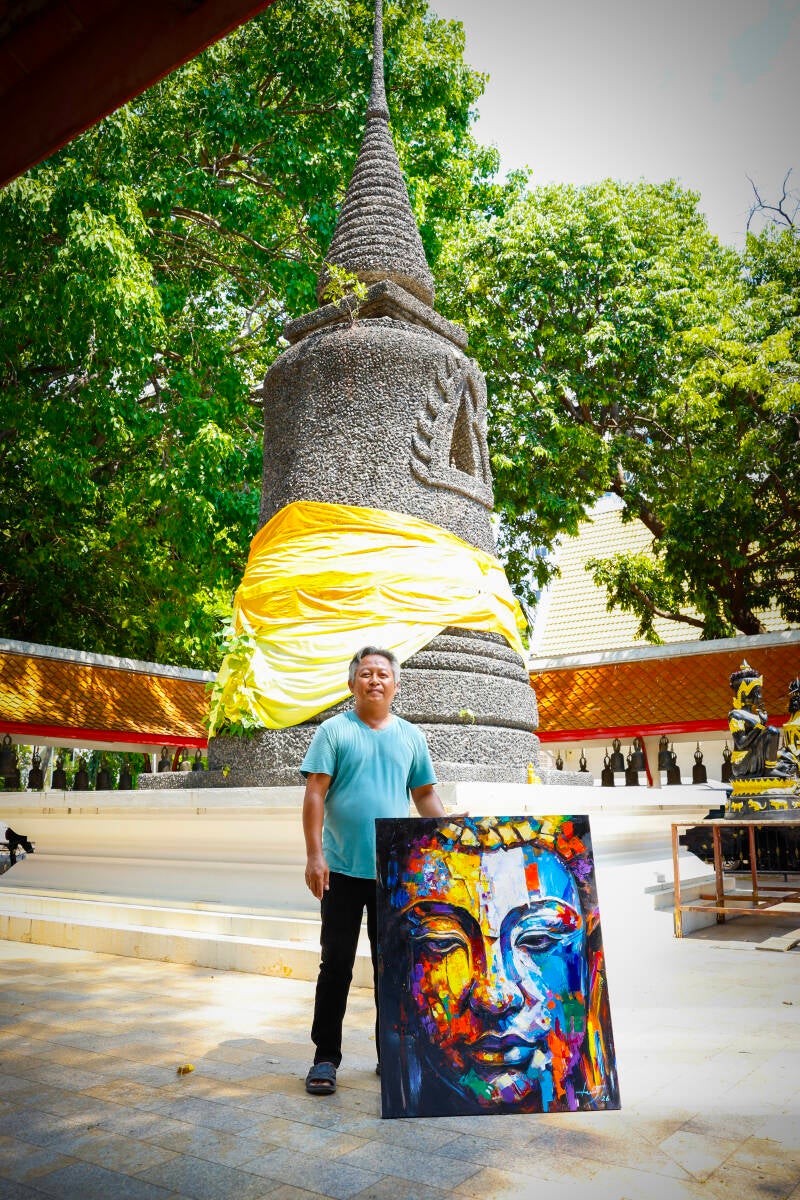
In this blog you will read how Original Buddha Art began after a meeting with Thai artist Seksak Jaichumchen and his Buddha paintings from Thailand.

The blessing of Buddha paintings
In this blog, you will learn why Buddha paintings in Thailand are blessed by a monk and the spiritual meaning behind this tradition.

Where do you place a Buddha painting?
In this blog, you will discover the best place to hang a Buddha painting according to Buddhist traditions and the symbolic meaning of respect, peace, and harmony.

Meaning of Buddha paintings in your home
In this blog, you will read about the meaning of a Buddha painting and why Buddha art is often chosen to bring peace, balance, and harmony into an interior.

Is it appropriate to have a Buddha at home?
In this blog, you will learn whether it is appropriate to have a Buddha image at home, how this is viewed in Thailand, and what Buddha art can represent in a living space.

What to consider when buying a Buddha painting?
In this blog, you will discover what to look for when choosing or buying a Buddha painting, from appearance and size to the meaning and origin of the artwork.

Buddha painting living room: tips & inspiration
In this blog, we share practical tips, inspiration, and examples to help you choose the perfect Buddha painting for your living room.

Buddha painting postures – meaning & buying guide
In this blog, you will learn the meaning of different Buddha painting postures and how to choose the right artwork that fits your interior and personal feeling.

Hand-painted or printed Buddha painting?
In this blog, you will learn what the difference is between a hand-painted and printed Buddha painting, and discover which choice best suits quality, appearance, and meaning.

What does a Buddha painting cost?
In this blog, you will learn what a Buddha painting costs, which factors determine the price, and why hand-painted, authentic art often has a higher value than prints.

Where to buy an authentic Buddha painting?
In this blog, you will learn where to buy a truly hand-painted Buddha painting and what to look for to recognize quality, authenticity, and visual appeal.

What does a laughing Buddha mean?
In this blog, you will discover what the laughing Buddha represents, where he comes from, and why he is a symbol of happiness, abundance, and inner contentment.